


If you’ve spent any time at an agency, you’ve heard some version of the same sentence a hundred times:
“We’re waiting on creative.”
And it’s usually said with a mix of calm acceptance and mild panic, because everyone knows what comes next. Deadlines don’t move. Media plans are already in motion. The client still expects results. And somehow, the agency ends up holding the bag.
When approvals take eight to ten days, timing stops being a tactic—and becomes the thing that breaks the campaign.
The uncomfortable truth: agencies pay the price for delays they don’t control
Work moves through layers: internal stakeholders, approvals, legal, brand, “just one more review,” and agencies inherit the timeline risk.
The result is predictable:
Meanwhile, the broader marketing world is feeling the same squeeze. Two-thirds (67%) of US marketing professionals say their teams regularly miss important cultural moments because of slow review and approval timelines.
That stat isn’t just about viral social moments. It’s about what happens when timing is the strategy, and timing gets eaten alive by process.
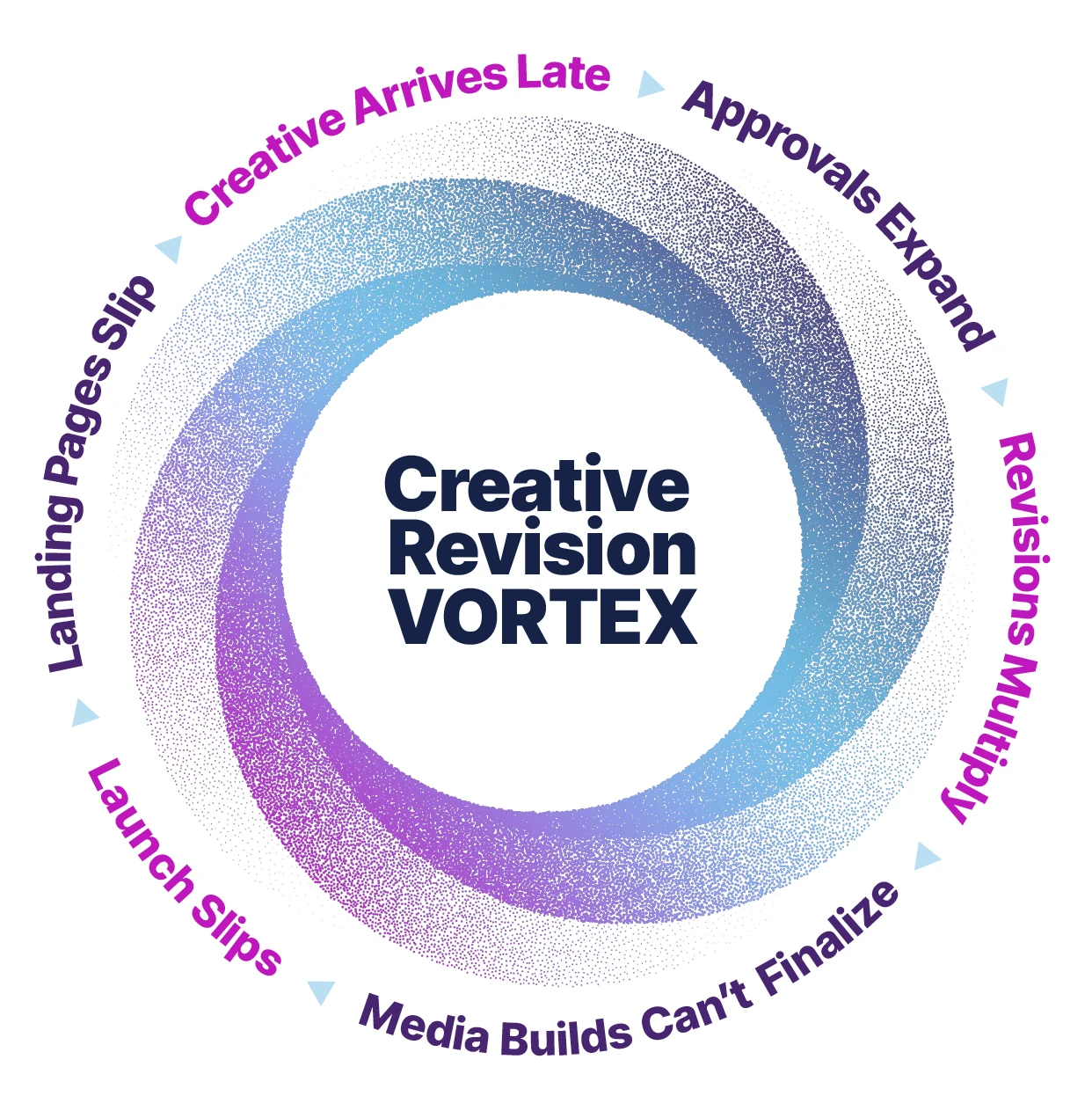
And here’s the part that should make every agency leader nod in painful recognition: waiting for feedback and chasing approvals are widely cited as the top things slowing down the creative process.
In that same research summary, brand-side teams reported it takes 10 days, on average, to get a piece of work approved. Separate reporting on creative review workflows shows that the average creative review process takes eight days and three versions to get sign-off.
Whether it’s eight days or ten, the takeaway is the same: the approval timeline is long enough to derail real-world go-to-market plans, especially when the calendar isn’t waiting.
The damage from the Revision Vortex isn’t just operational. It hits the three places agencies feel it most.
When a launch is late, you don’t just miss a date, you miss campaign momentum.
Even when the blocker is upstream, the question tends to land on the agency:
“Why didn’t this launch?”
That’s how process problems become perception problems.
This is where it gets expensive:
And there’s one more quiet cost: reputation risk. When timelines get messy, the agency can start to look “difficult to work with.”
Delays are predictable. Revision churn is predictable. Launch lag is predictable.
The winners don’t “try harder.” They build an approach that:
When timelines compress, the right support reduces downstream rework and protects launch quality.
Here are the capability areas that matter most when you’re stuck in approvals, revision loops, or late-asset territory:
Look for teams that can take raw or late creative and turn it into platform-ready, spec-compliant assets quickly:
This is where a lot of timelines silently die: the “creative” exists, but it isn’t launch-ready.
In delay scenarios, agencies need a partner who can keep the engine moving while creative catches up:
Strategy isn’t helpful if it can’t survive the review loop. Look for support that can:
Creative delays often expose a second bottleneck: the page isn’t ready. Strong execution layers can:
This is the quiet superpower. The best support brings process discipline:
When you watch the most effective teams operate, you’ll notice they aren’t magically faster. They’re just structured in a way that makes delays survivable.
They do things like:
If you’re evaluating help, whether it’s a bench, a specialist, or a full execution layer, keep it simple:
The Revision Vortex isn’t going away. Creative will land late sometimes. Approvals will expand. And timelines will compress.
The question is whether your team absorbs that shock alone, or whether you have an execution layer that can step in when the clock starts running out.
If you want to protect both quality and sanity, start here:
That’s how you keep launches on track without turning every delay into a fire drill.

Blog


Campaign Quick Facts

Here’s What Our Client Has to Say
About the Client

Results and Successes
DOWNLOAD THE CASE STUDY NOW
Build Your Strongest Pipeline Yet

The AI Mode is an entirely new Google product — a hybrid experience bridging traditional Search and Gemini that could redefine how users interact with results.

.webp)
Simply ranking on page one is no longer enough if your content doesn’t meet the searcher’s intent in a comprehensive and valuable way.













8240 North Mopac Expressway, Suite 250, Austin, Texas 78759 | 512-388-2300 | Sales@Q1Media.com
Copyright © 2025 Q1Media | All Rights Reserved | Privacy Policy
