
One of the most common mistakes in programmatic strategy is starting with the platform instead of the audience.
Think of it like the stock market, but for ad space on the internet.
Instead of traders buying and selling stocks, programmatic is bidding on digital ad placements in real time. Websites, apps, and streaming platforms make their ad space available, and advertisers bid on that space to get their message in front of the right audience. All of this happens in milliseconds, automatically, before a page even fully loads.
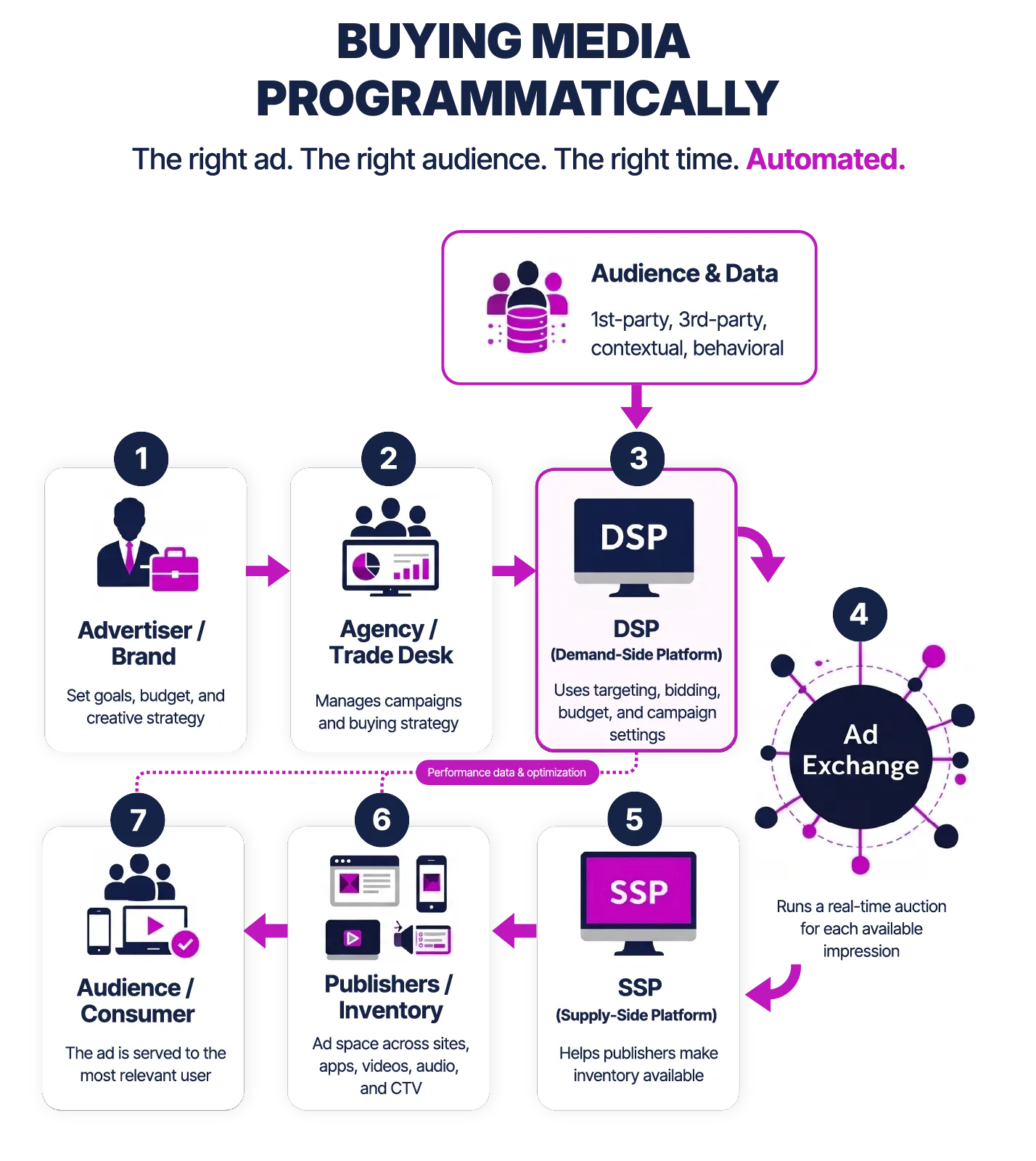
The simplest way to put it: programmatic is about getting the right ad in front of the right person at the right moment. And it’s not a small corner of the market. eMarketer projects U.S. programmatic ad spending will top $200B in 2026.
Programmatic advertising runs across streaming TV, digital billboards, music apps, podcasts, mobile games, and more. Wherever there's a digital screen (or speaker), there's likely a programmatic opportunity.
Before diving in, it helps to understand what programmatic actually is: not a single tactic, but the technology used to buy a wide range of digital media. Most programmatic tactics live toward the upper funnel, focused on building awareness and consideration. That said, it's not exclusively upper funnel. Retargeting, for instance, can drive real conversion activity. It just does so differently than search or social. Think of programmatic as full-funnel technology that does its heaviest lifting at the top.
Here's why that matters. When someone is on a news site reading about last night's game, they're there with a purpose. They're not looking to click an ad, but are looking at box scores. Programmatic reaches people while they're doing something else, which is fundamentally different from paid search, where someone is actively looking for what you offer.
That doesn't make programmatic any less effective. Programmatic builds awareness, stays top of mind, and moves people down the funnel over time. It complements other tactics rather than replacing them. And it's definitely not a blind-reach approach. Targeting by behavior, location, interests, purchase intent, and retargeting (reaching people who've already visited your site or engaged with your ads) means your ads reach a real, qualified audience.
Not all programmatic is the same. Here's how the main formats break down, ordered from broadest awareness at the top to more direct-action tactics toward the bottom.
When most people hear "digital billboard," they picture the highway. But digital out-of-home advertising is everywhere: gas station pump screens, airport corridors, bus shelters, elevator panels, venue displays, the list goes on.
What makes DOOH special is its sheer presence. You can't scroll past a billboard. You can't close it. It just is. Big, bright, and impossible to ignore. And unlike traditional static billboards, DOOH can rotate creative, change messaging throughout the day, and even respond to context like weather or time of day.
A coffee brand, for example, might promote hot drinks during a cold morning commute and switch to iced beverages when the afternoon heat kicks in. A restaurant might run breakfast messaging in the morning and dinner specials in the evening.
The goal here is pure visibility and presence, and for advertisers who need to own a market, that's everything.
Two terms worth knowing before we go further: CTV and OTT. They're related but distinct.
CTV (Connected TV) is the device, the television on your wall. Smart TVs, Apple TV, Roku, Fire Stick.
OTT (Over-The-Top) is the content: Hulu, Peacock, Paramount+, YouTube TV, and the ad-supported tiers of Amazon Prime and Netflix.
CTV is the television experience. OTT is the streaming content.
When OTT content plays on a connected TV, you get the most premium programmatic format available: a predominantly non-skippable ad on the largest screen in someone's home.
Completion rates are high. Audiences are engaged. And unlike traditional broadcast TV, you're not buying a time slot and hoping the right demographic happens to be watching. Instead, you're targeting a specific, qualified audience with precision.
A format worth highlighting: Pause Ads. When a viewer pauses their show, a branded ad takes over the screen, no skip button, no scroll, just your message owning the room in a moment of genuine attention. It's one of the most underrated placements in programmatic.
CTV/OTT is the most premium programmatic format, and it carries a higher Cost Per Mille (CPM) to match. But for brand storytelling, product launches, and high-impact awareness campaigns, nothing quite compares to the living room screen.
One important note: just because you want your brand on Hulu doesn't mean your audience is there. The best programmatic strategy starts with where your audience actually spends their time, not where you personally think they should be.
Audio advertising, whether through streaming music platforms, podcasts, or digital radio, is one of the most underrated formats in the programmatic mix.
Here's why: when someone puts on music or a podcast, they're not passively scrolling but have made an active choice about what they want to hear. Picture someone working from home with Spotify running in the background, or sitting at their office desk listening to a podcast while clearing through emails between meetings. That's potentially eight hours of the day where an audience is reachable, engaged, and not fighting through a wall of competing content to find you.
Audio feels personal in a way most digital channels don't. Less like an ad, more like a voice riding shotgun. The result is a less cluttered, more human experience, and messages that land differently as a result.
There are still millions of people who choose not to pay for premium subscriptions. They listen to free Spotify, free Pandora, and ad-supported podcasts, which means they're reachable. For scale, Spotify alone reported 751 million monthly active users in Q4 2025. Audio is a powerful way to reach them in a moment when they're already listening.
Online Video (OLV) is a broad category of video advertising that includes several formats: pre-roll, in-stream, out-stream, in-feed, and more. The most familiar of these is pre-roll, the 15 to 30-second ad that plays before digital content. You're on a site, you click to watch a video, and a short ad plays first. Depending on the inventory, it may be skippable after 5 seconds or non-skippable entirely.
What makes pre-roll powerful is its ability to tell a story. A display banner can catch an eye, but a video can make you feel something. For brand storytelling, emotional campaigns, and product launches, pre-roll is a natural fit. People are already in content-consumption mode when watching a video online. At that point, they're settled, they're watching, and a message can hold their attention in a way a static banner simply can't.
Pre-roll sits a step closer to the middle of the funnel than CTV, digital audio,or DOOH, making it a strong bridge between awareness and action.
Display ads are the standard banner placements you see on websites and apps. They are the 300x250 square on the right side of an article, the leaderboard banner across the top, and the ad that loads between content on your phone. They can be static or animated, and they live across a massive range of websites, apps, and online content.
Display doesn't have the dramatic impact of a CTV spot or the presence of a digital billboard. But it doesn't need to. Its job is presence, not spectacle. More impressions per dollar means more touchpoints, more moments where your brand shows up while someone is already engaged with content they chose to consume. That consistent visibility builds familiarity over time, and familiarity drives action.
Think of display as the tactic that keeps you present. While someone is reading the news, checking a basketball score, or browsing a site, your brand is there. Quick call to action, mass reach, and consistent visibility, that's the display advantage.
Ever looked at a pair of shoes online and then watched them follow you around the internet for the next two weeks? That's retargeting. And it's not a glitch, it's one of programmatic's most powerful tools.
Retargeting works by re-engaging users who have already shown interest in your brand. There are several ways this can happen:
These formats can also work sequentially. Think of it as 'if this, then that' advertising: if they watched your CTV ad, serve them a display ad. If they visited your site but didn't convert, follow up with a more specific offer. If they walked into a competitor's location, reach them before they make a decision. Each touchpoint builds on the last.
That location-based example is particularly powerful. Imagine someone attended a local home and garden expo. They're clearly in-market for home improvement. Serving them targeted ads in the days following that visit is a very different approach from casting a wide net and hoping.
You'll hear these terms come up, and they're worth knowing, even at a high level.
DSP (Demand-Side Platform) — This is the advertiser's side. A DSP is the technology platform where ad buying and bidding happen in real time. Think of it as the engine running the auction. The Trade Desk is a well-known example. Advertisers and agencies use DSPs to set targeting, budget, bidding strategy, and creative.
SSP (Supply-Side Platform) — This is the publisher's side. An SSP is the technology that makes ad inventory available for purchase. Publishers (websites, apps, streaming platforms) use SSPs to sell their ad space programmatically.
In between these two sits the ad exchange — a marketplace where buyers and sellers connect. The whole ecosystem is genuinely complex, with data management platforms, ad servers, and verification layers all playing a role. But the core idea is simple: advertisers want to reach people, publishers have space to fill, and programmatic infrastructure connects them at scale, in real time.
There's a lot of buzz right now about Artificial Intelligence (AI) in marketing. But here's something worth knowing: AI has been part of programmatic for decades. The real-time bidding algorithms, audience modeling, optimization engines, these DSPs and data platforms have been using machine learning long before it was a headline.
What that means is that programmatic isn't suddenly becoming AI-powered. It always was.
But that automation still needs a human hand. AI optimizes toward patterns, but it doesn't know your client's business, their goals, their seasonality, or the nuance behind a campaign pivot. That’s why working with an experienced programmatic team matters. They review performance, catch what the algorithm misses, and make judgment calls that a machine simply isn't equipped to make, keeping your campaigns actively managed.
Think of AI as a powerful tool within programmatic, not the whole strategy.
One of the most common mistakes in programmatic strategy is starting with the platform instead of the audience.
You might say, 'I want my brand on Amazon Prime Video,' but is your audience actually watching Prime Video? Or picture a brand that targets elderly customers but places budget into TikTok. Or a vendor recommending their own proprietary inventory because it's cheaper for them to sell, not because it's right for your goals.
The better approach is a platform-agnostic strategy: start with who you're trying to reach, understand where they spend their time digitally, and then build the channel mix around that reality. Audience first, platform second.
It's also worth remembering: you are not your audience. What you watch, listen to, and browse is probably not a reliable map of your customer's behavior. Data should drive that conversation, not assumptions.
The first campaign is always a learning exercise. The data you collect informs everything that comes after.
Programmatic campaigns are living things. Goals shift. Performance data tells new stories. An audience segment that seemed right in month one might need to evolve by month three. For example, data may reveal that the budget initially allocated to streaming audio would be better invested in pre-roll, giving you the flexibility to optimize toward what's actually working.
The ability to pivot quickly, to move spend, adjust targeting, test new creative, or shift channel mix, is one of programmatic's greatest strengths. It requires the team managing your campaign to actively read the signals and make smart decisions in real time.
Programmatic advertising is one of the most sophisticated, scalable, and targeted ways to reach an audience in digital media. It spans everything from the digital billboard you saw on your way to work this morning to the ad that played before your podcast, the banner on your favorite news site, and the QR code that popped up when you paused the rewatch of your favorite show last night.
Understanding the formats, how they fit the funnel, and how to use them without platform bias is what separates a decent programmatic strategy from a great one.
The internet isn't free, and programmatic is the engine that keeps it running. Your brand should show up in it well.

Blog


Campaign Quick Facts

Here’s What Our Client Has to Say
About the Client

Results and Successes
DOWNLOAD THE CASE STUDY NOW
Build Your Strongest Pipeline Yet

Discover four summer marketing trends reshaping brand reach. Embrace AI, boost local awareness, and drive engagement with interactive ads. Learn more!

.webp)
Simply ranking on page one is no longer enough if your content doesn’t meet the searcher’s intent in a comprehensive and valuable way.













8240 North Mopac Expressway, Suite 250, Austin, Texas 78759 | 512-388-2300 | Sales@Q1Media.com
Copyright © 2025 Q1Media | All Rights Reserved | Privacy Policy